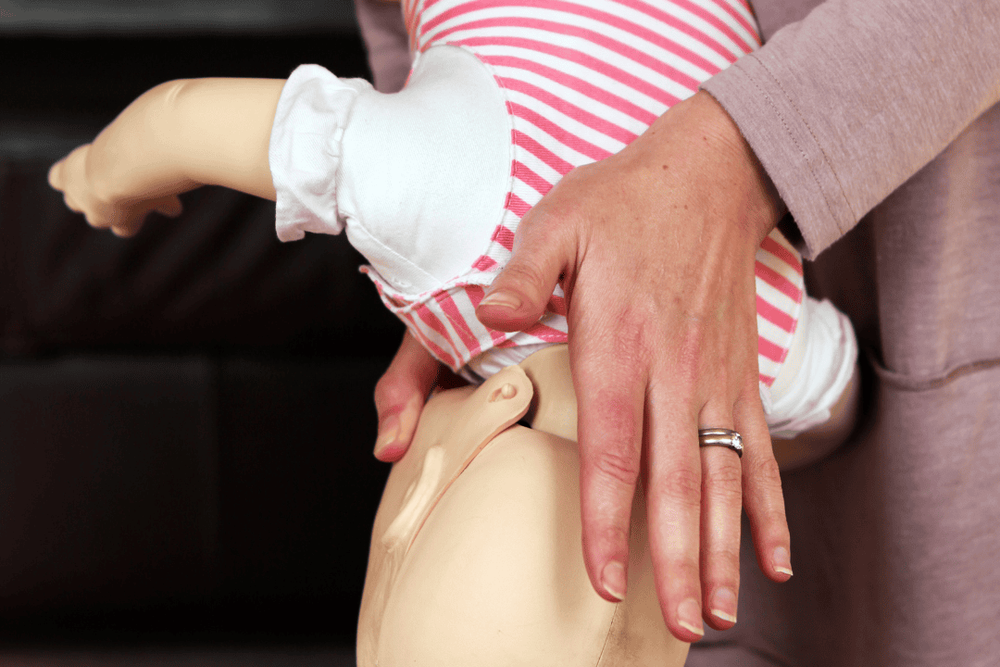
Risk of choking: preventing choking accidents in children
from Sarina

Sarah, what size of objects are particularly dangerous for toddlers?
Sarah: Both very small and larger round objects can be life-threatening for children, but for different reasons. Small objects such as peanuts or beads can enter the airway and become lodged there. Objects as small as 8 mm in diameter, for example a peanut, can completely block the airway of a toddler.
What is problematic about larger objects?
Larger objects are especially dangerous when they are round, such as cherry tomatoes, grapes, or candies. These may not fit into the windpipe, but they can become stuck at the upper entrance of the larynx or in the throat and block the airway from the outside, which can also lead to choking.
Smooth or elastic objects that stick tightly to tissue or cannot be chewed are particularly dangerous. Examples include balloons or marshmallows.
How should parents handle foods that have a risky shape?
The European toy safety standard EN 71-1 classifies objects smaller than 31.7 mm as hazardous. However, this threshold is not strict enough when it comes to food, especially round foods.
Grapes and cherry tomatoes have smaller diameters, but because of their spherical shape and smooth surface they can seal the lower throat airtight. Clinical case reports show that whole grapes lodged in the throat are fatal in about 23% of cases.
For this reason, I recommend that parents cut round foods into pieces:
- Grapes: Cut lengthwise into quarters. This reduces the diameter to less than 10 mm. From about two years of age, halving the grapes is usually sufficient.
- Cherry tomatoes: Cut in half or quarters, similar to grapes.
- Hot dogs (sausages): Cut lengthwise first and then into small pieces. Important: do not cut them into round slices, as these are particularly dangerous. In their original shape they fit exactly into the throat and can seal the entrance to the larynx airtight, leading to immediate choking.
What about foods that are smaller than a peanut, such as rice?
Foods smaller than a peanut are generally not problematic, because they are usually swallowed rather than inhaled. Even if they do enter the airway, they typically do not become stuck and can usually be coughed out.
Individual grains of rice rarely cause a complete airway blockage, because mucus binds them and the tiny hairs in the airway move them out again, almost like on a conveyor belt.
An exception is sticky rice. Foods such as mochi or rice balls can become dangerous because of their adhesive consistency. They can easily stick in the throat and should therefore be avoided until about five years of age.
It is helpful to know that mixing rice or similar foods with a little liquid makes them easier to swallow and reduces the risk of choking.
What else is important when it comes to eating and eating behavior?
Children should sit calmly and upright while eating. They should not run around or play with food in their mouth.
If a child laughs, cries, or talks while eating, even very small food particles can accidentally enter the airway.
Toddlers should also not be fed in the car or stroller. Movement increases the risk of choking, and in an emergency it may not be possible to intervene immediately.
Raw, hard fruits and vegetables are unsuitable for young children. For children under three years of age, foods such as carrots or apples should only be offered cooked, finely grated, or cut into very small pieces.
Children should not be pressured to eat or distracted, for example by screens. Distractions reduce attention while eating and therefore increase the risk of choking.
At what age can children eat whole grapes or nuts?
This question is often asked, and recommendations do vary. Some sources suggest three years of age, while others recommend waiting until four.
Scientific evidence shows that the greatest risk clearly decreases after the fourth birthday. Statistically, about 78% of all choking incidents occur in children before the age of four.
The reason is that the swallowing reflex, controlled tongue and jaw movements, and the ability to position food in the mouth develop fully only between the ages of three and four.
Safe eating is closely linked to the maturation of the nervous system. Two areas are particularly important: the nerves that control chewing and facial sensations, and the brain centers responsible for attention, movement coordination, and impulse control, for example preventing a child from chewing and talking at the same time.
fMRI studies show that three-year-olds have developed these abilities only to about 63% of adult capacity. This means that even if a child appears to chew safely, important protective reflexes and fine motor control are often still missing to reliably handle round, hard, or smooth foods such as whole grapes, nuts, or raw carrot pieces.
Why are batteries so dangerous?
Lithium button batteries such as CR2032 create pH values above 12 within 120 minutes when they come into contact with saliva. This causes tissue in the esophagus to dissolve because it is chemically burned and destroyed.
The resulting electrical currents can cause deep tissue damage, which in about 15% of cases leads to a fatal inflammation in the chest cavity between the heart and lungs.
How can I tell if my child has swallowed a battery?
Unfortunately, often you cannot. About 62% of affected children initially show no symptoms until it may already be too late.
If symptoms occur, they are often nonspecific or delayed. Possible signs include difficulty swallowing, coughing, vomiting, chest pain, or increased salivation.
In some cases children show no symptoms at first, even though severe internal damage is already developing.
What should I do if my child has swallowed a battery?
Immediate medical evaluation is essential, even if the child shows no symptoms.
If available and if the ingestion occurred less than 12 hours ago, the child can be given two teaspoons of sucralfate suspension (1 g/10 ml) every 10 minutes up to three times. Sucralfate requires a prescription.
As an alternative, honey may be given if the child is older than 12 months. The recommended dose is two teaspoons every 10 minutes up to six times.
What makes swallowed magnets especially dangerous?
If only one magnet is swallowed, it is usually not immediately dangerous and may pass through the digestive system.
However, if two or more magnets are swallowed, even at different times, they can attract each other through the walls of the intestines. This can trap parts of the intestine, causing bowel obstruction, tissue damage, or even intestinal perforation.
Particularly dangerous are small, strong neodymium magnets, for example those found in magnetic ball sets, magnetic building toys, piercing-like toys, or magnetic parts in poorly manufactured toys that can easily come loose.
Which objects that parents might not immediately think of are also dangerous?
Pieces of balloons are among the most dangerous objects. According to the American Academy of Pediatrics, they are one of the most common causes of fatal choking related to toys. Because they adapt to the airway, they are extremely difficult to remove.
Foam pieces, packaging peanuts, and styrofoam are also dangerous, as children often mistake them for food. They can mix with saliva in the throat and form a paste that blocks the airway.
Sharp or pointed objects also pose a risk. Examples include thumbtacks, pins, paper clips, glass shards from broken toys, or pointed jewelry parts such as earring backs. If swallowed, these objects can puncture the esophagus, stomach, or intestines, leading to internal bleeding, inflammation, or even life-threatening injuries.
What else should parents know to prevent choking accidents?
Many choking accidents do not happen at home but in unfamiliar environments such as relatives’ homes, vacation rentals, or hotels, places that are often not childproof. Pay particular attention there to small objects, accessible medications, or unsuitable foods.
Time of day also plays a role. The risk often increases during dinner. Children are tired, their motor control decreases, and parental attention may also be lower. Many accidents happen when children are almost falling asleep while eating or are no longer chewing attentively.
Another important point: children learn through observation. When adults talk with food in their mouths or put objects into their mouths, they unintentionally model unsafe behavior. Children quickly copy these actions, sometimes with dangerous consequences.
🚨 Be prepared for emergencies 🚨
Despite all precautions, there is no 100 percent safety. What helps is being prepared for emergencies. In the free demo course from Sanio, you can refresh your knowledge.

Sarina is mum to two little boys and a stepmum to three older children, whom the little ones look up to. When all five are at home, the noise levels and fun factor go through the roof.
This blog post was published on 6 June 2025. It was produced in collaboration with Sarah Jerjen, MSc in Health Sciences, and Sanio.
Links:
www.sanio.ch
Information about the online course: www.sanio.ch/erste-hilfe-online-am-kind
Sources:
Palanjian, 2023, NHS UK, 2024, BVKJ, 2017, Committee on Injury, Violence and Poison Prevention, 2010, Universitätsklinikum Regensburg, 2023, Benioff Childrens Hospital, 2022, R+V, 2023, Litoviz, 2000, Bundesinstitut für Risikobewertung, 2022, Aponet, 2024
Have you already known the famido app?

Download now and experience more
With famido you can experience more and pay less
Comments
Write the first comment