Alcohol during pregnancy: risks and recommendations
from Sarina
Why is alcohol during pregnancy so harmful?
Alcohol is toxic to cells and to the body. For this reason, it can also cause serious damage to an embryo or fetus. The placenta plays a central role in supplying the baby during pregnancy. It transfers nutrients and oxygen but does not filter out all harmful substances. When you drink alcohol, it passes through the placenta directly into your baby’s bloodstream. This means your baby absorbs the same amount of alcohol as you do. The difference is that it takes much longer for the baby to break down alcohol because its liver is not yet fully developed.
What are the consequences of drinking alcohol during pregnancy?
Alcohol consumption can harm the unborn child in different ways:
- Fetal alcohol spectrum disorders (FASD). This term includes all health impairments caused by alcohol consumption during pregnancy, ranging from mild cognitive deficits to severe developmental disorders. It is estimated that at least 1,700 children in Switzerland are affected each year.
- Fetal alcohol syndrome (FAS). This is the most severe form and can lead to physical, mental and neurological damage. Children with FAS may have physical abnormalities, developmental delays, learning difficulties and behavioral problems.
- Increased risk of miscarriage and premature birth. Alcohol increases the risk of pregnancy complications such as miscarriage or preterm birth.
How much alcohol is safe during pregnancy?
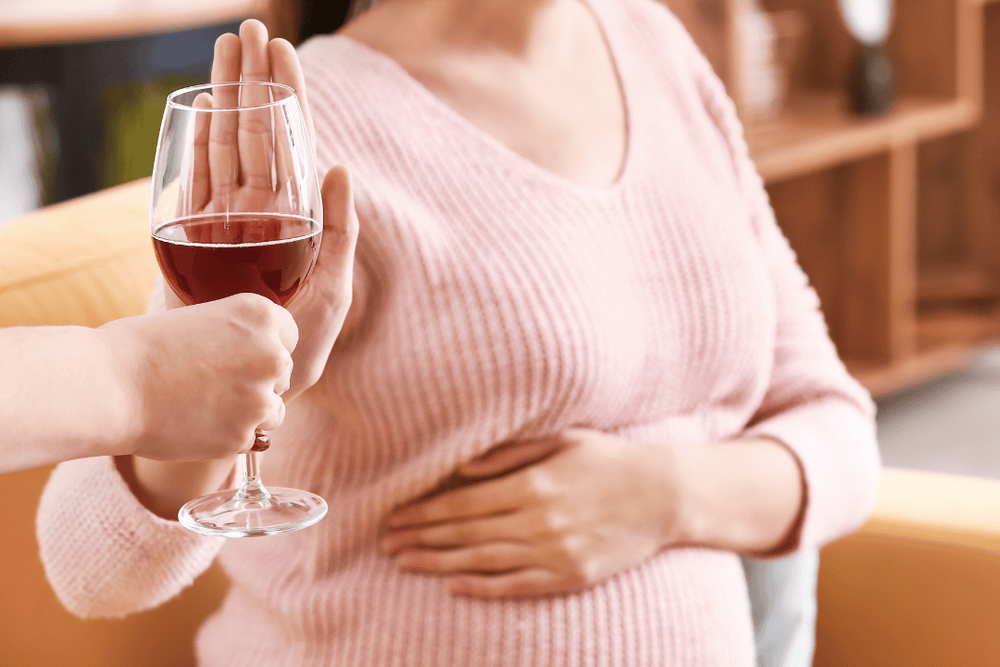
Scientific studies have not identified a “safe” amount of alcohol during pregnancy. Even if you may have heard that an occasional glass of wine does no harm, experts clearly advise against it. There is simply no guarantee that even small amounts are harmless. The clear recommendation is therefore to avoid alcohol entirely throughout pregnancy in order to eliminate any risk to the baby. This also applies when planning a pregnancy. Avoiding alcohol from the beginning is the safest approach.
What alternatives are suitable?
It can sometimes be difficult to completely avoid alcohol, especially in social situations. It may help to find alcohol-free alternatives that you can enjoy just as much. Today there are many delicious non-alcoholic drinks, from alcohol-free sparkling wine to creative mocktails.
Be careful: beers, sparkling wines and wines labeled “alcohol-free” may still contain up to 0.5% alcohol by volume. To make sure there is truly no alcohol, choose drinks labeled 0.0%.
What should I do if I drank alcohol?
If you unknowingly drank alcohol during the first weeks of your pregnancy, try not to worry too much. The most important thing is to stop drinking alcohol as soon as you find out that you are pregnant. Speak openly with your doctor or midwife about it so that potential risks can be better assessed and any necessary precautions can be taken.
I find it difficult to stop drinking alcohol. Where can I get help?
Avoiding alcohol can be challenging, especially during pregnancy. If you notice that it is difficult for you, do not hesitate to seek support early. Even a conversation at an outpatient counseling center or participation in a support group can help. Your gynecologist, midwife or general practitioner can also support you. You do not have to go through this alone. People around you can also help, for example by accompanying you to counseling and encouraging you.
Admitting that you have lost control over alcohol consumption can be difficult and often comes with feelings of shame. Many women fear being perceived as a bad mother, which can make seeking help harder. It is important to know that substance use problems affect many people and are not a sign of weakness. Professionals in addiction counseling centers and support groups approach those affected without judgment and are bound by confidentiality.
What are the most common myths about alcohol during pregnancy?
- “An occasional glass won’t hurt.” Many people believe that small amounts of alcohol, such as a glass of wine or beer from time to time, are harmless. However, there is no safe amount of alcohol during pregnancy and no safe time when alcohol cannot affect the unborn child. Even small amounts can influence the baby’s development, especially in the early weeks when organs and the nervous system are forming. Drinking alcohol occasionally can also lead to binge drinking, meaning consuming a large amount of alcohol at once, which carries particular risks.
- “Alcohol is only dangerous in the first trimester.” Although the first trimester is particularly critical, alcohol consumption remains risky throughout the entire pregnancy. The baby’s brain develops during the whole pregnancy, and alcohol can cause damage even later.
- “Only heavy drinking is a problem.” It is often assumed that only heavy or regular alcohol consumption leads to problems. The amount does indeed matter. The more and the more often a baby is exposed to alcohol, the greater the risk. However, even occasional drinking can increase the risk of fetal alcohol spectrum disorders (FASD), which may cause cognitive and physical impairments.
- “I drank alcohol early in pregnancy, so it’s too late now.” A common misconception is that there is no point in avoiding alcohol if it was consumed at the beginning of pregnancy. In reality, it is never too late to stop drinking. Avoiding alcohol at any point reduces the risk of further harm to the baby.
- “Alcohol helps me relax, and that’s good for my baby.” Reducing stress is important, but alcohol is not a safe way to cope with stress, especially during pregnancy. Healthier alternatives include relaxation techniques, physical activity or talking with someone you trust.
- “Everyone drinks a little during pregnancy.” This misconception often arises from hearing that some women occasionally drank alcohol during pregnancy without obvious problems. In reality, most women stop drinking alcohol completely once they learn they are pregnant. Research also shows that even small amounts of alcohol can increase the risk of developmental disorders. Not every child will show immediate symptoms, but the risks are still present.
- “If I don’t feel it, my baby doesn’t feel it either.” Sometimes people assume alcohol is only harmful if the mother feels its effects, such as being intoxicated. However, a baby’s body is much more sensitive to alcohol, and long-term damage can occur even if the mother does not strongly notice the effects.
Can I cook with alcohol during pregnancy?
Another common misconception is that alcohol completely evaporates during cooking. Even after long cooking times, some alcohol often remains in the dish. How much alcohol remains depends on several factors. One of the most important is cooking time. The longer the dish cooks, the more alcohol evaporates, but it never disappears completely. After about 2.5 hours of cooking, up to 5% of the alcohol can still remain in the food. Temperature also plays a role. At lower temperatures, less alcohol evaporates. The amount of alcohol used and the cooking method also influence the final alcohol content.
It is best to avoid dishes containing alcohol during pregnancy in order to eliminate any risk to the baby. If you want to prepare a recipe that traditionally contains alcohol, try cooking it for a long time or use alcohol-free alternatives instead. This allows you to enjoy the flavor without worrying.
What about alcohol in food products?
Alcohol is not only found in drinks and cooked dishes but also in certain foods such as fruits, desserts or processed products. Overripe fruits like bananas or grapes can contain small amounts of alcohol due to natural fermentation. These quantities are usually so small that they do not pose a significant risk. However, if you want to be extra cautious, you may prefer to avoid very overripe fruits.
Many processed foods also contain alcohol, for example baked goods (such as cakes with liqueur), desserts like tiramisu, or sauces and dressings. Because these foods are often not heated long enough, some alcohol may remain. It is therefore best to read product labels carefully.

Sarina is mum to two little boys and a stepmum to three older children, whom the little ones look up to. When all five are at home, the noise levels and fun factor go through the roof.
This blog post was published on 16 January 2025. It is based on schwangerschaft-ohne-alkohol.ch and was produced in collaboration with Rachel Stauffer Babel, Senior Prevention Project Manager at Addiction Switzerland.
Sources:
schwangerschaft-ohne-alkohol.ch
www.suchtschweiz.ch
www.bag.admin.ch/dam/bag/de/dokumente/npp/alkohol/gesundheitliche-risiken/fs-alkohol-schwangerschaft.pdf.download.pdf/fs-alkohol-schwangerschaft.pdf
shop.addictionsuisse.ch/de/alkohol/345-im-fokus-alkohol-und-schwangerschaft.html
Useful links:
Regional alcohol and addiction support services: www.suchtindex.ch
Self-help groups: sselbsthilfeschweiz.ch, Anonyme Alkoholiker, Narcotics Anonymous
Online counselling: safezone.ch, iris-plattform.de
Have you already known the famido app?

Download now and experience more
With famido you can experience more and pay less
Comments
Write the first comment